pattern

Land Transportation - Train and Locomotive Parts

Here you will learn some English words related to train and locomotive parts such as "cowcatcher", "boiler", and "firebox."

Review

Flashcards

Forms

Spelling

Quiz

Start learning
Words Related to Land Transportation
builder's plate

a metal or plastic plaque that displays important information about a piece of machinery or equipment

Ex: The builder's plate on the locomotive indicated its manufacturer and production date. 
Close
Sign in
cowcatcher

a device mounted at the front of a locomotive to clear obstacles from the tracks

Ex: The cowcatcher helped deflect debris away from the tracks. 
Close
Sign in
air brake
air brake
[noun]

a device on a vehicle that uses compressed air to slow down or stop its motion

Ex: Trains rely on air brakes to safely slow down and stop, especially when hauling heavy loads over long distances. 
Close
Sign in
vacuum brake

a braking system that uses suction to apply brakes, commonly found in older railway systems

Ex: Trains equipped with a vacuum brake system rely on air pressure differences to slow down and stop the locomotive. 
Close
Sign in
emergency brake

a safety device used to stop the train quickly in urgent situations

Ex: When a passenger pulled the emergency brake, the train came to a sudden halt, causing some confusion among the passengers. 
Close
Sign in
reverser handle

a lever used to control the direction of movement of the train's engine

Ex: The engineer adjusted the reverser handle to switch the locomotive from forward to reverse gear. 
Close
Sign in
boiler
boiler
[noun]

a closed vessel in which water is heated to create steam or hot water, used for heating buildings, producing electricity, or powering machines

Ex: The building’s boiler provides hot water and heating during the winter. 
Close
Sign in
coal pusher

a mechanical device used to automatically feed coal into a furnace or boiler to sustain continuous operation

Ex: The coal pusher automatically feeds coal into the furnace, keeping the boiler running smoothly. 
Close
Sign in
feedwater heater

a device used in power plants to preheat water before it enters the boiler

Ex: Feedwater heaters help improve the efficiency of power plants by recovering waste heat from steam. 
Close
Sign in
firebox
firebox
[noun]

the chamber in a steam locomotive where fuel is burned to heat water and produce steam

Ex: She monitored the temperature inside the firebox. 
Close
Sign in
sandbox
sandbox
[noun]

a container for storing sand, used to improve traction between the wheels of a train and the rails

Ex: Sandboxes in trains are crucial for preventing wheel slippage during adverse weather conditions such as rain or snow. 
Close
Sign in
smokebox
smokebox
[noun]

a part of a steam engine where smoke and gases from burning fuel exit into the atmosphere

Ex: The locomotive's smokebox was designed to efficiently expel smoke and steam generated by its engine. 
Close
Sign in
tender
tender
[noun]

a car attached to a steam locomotive to carry fuel and water

Ex: The tender held enough coal and water for the long journey. 
Close
Sign in
train horn

a loud device used by trains to signal their approach or presence

Ex: When the train horn sounded, everyone at the crossing knew to stay clear of the tracks. 
Close
Sign in
whistle
whistle
[noun]

a device mounted on locomotives and some railcars that emits a loud, high-pitched sound to signal warnings or communicate with personnel and other trains

Ex: The engineer sounded the whistle to alert workers on the tracks of the approaching train. 
Close
Sign in
ditch light

a bright lamp mounted on the front of a locomotive or train to illuminate the tracks ahead and improve safety during night travel

Ex: Ditch lights help train operators see obstacles on the tracks in low-light conditions. 
Close
Sign in
train wheel

a large metal disk that rotates to help a train move along tracks

Ex: Train wheels are designed to endure long journeys without needing frequent replacement. 
Close
Sign in
bogie
bogie
[noun]

a set of wheels and axles used in various types of rolling stock, such as freight cars or passenger coaches

Ex: Freight trains rely on sturdy bogies to transport heavy cargo across long distances. 
Close
Sign in
brakeman's caboose

the rear car of a freight train where the crew monitors operations and controls the brakes
Ex: The brakeman's caboose is essential for ensuring the safe operation of the train by managing its braking systems. 
Close
Sign in
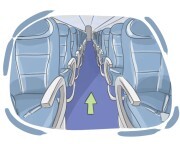
gangway
gangway
[noun]

a passage between rows of seats in an auditorium, aircraft, etc.

Close
Sign in
compartment

any of the separate sections within a passenger train carriage, typically enclosed by walls and equipped with seats

Ex: We booked a private compartment for our overnight train journey. 
Close
Sign in
vestibule
vestibule
[noun]

a small, enclosed area between train cars where passengers can move from one car to another

Ex: The vestibule of the train was crowded as passengers hurriedly switched between cars during the rush hour. 
Close
Sign in
coupling
coupling
[noun]

the mechanism used to connect railroad cars together

Ex: The coupling locked the cars together for the journey. 
Close
Sign in
coupling rod

a rigid bar that connects the wheels of adjacent railway vehicles to synchronize their movement

Ex: The coupling rod transfers power between the wheels of the locomotive, ensuring coordinated movement. 
Close
Sign in
cut lever
cut lever
[noun]

a device used by railway personnel to operate the couplers between train cars

Ex: The conductor pulled the cut lever to uncouple the freight cars at the rail yard. 
Close
Sign in
pantograph

a component of an electric train that connects it to overhead wires for drawing power

Ex: The pantograph on an electric train extends upwards to make contact with the overhead wires, ensuring continuous power supply. 
Close
Sign in
LanGeek
Download LanGeek app