pattern

Vocabulary for IELTS Academic (Band 6-7) - Geology

Here, you will learn some English words related to Geology that are necessary for the Academic IELTS exam.

Review

Flashcards

Forms

Spelling

Quiz

Start learning
Vocabulary for Academic IELTS (6-7)
crust
crust
[noun]

the outermost layer of the Earth, consisting of solid rock and divided into the continental crust and the oceanic crust

Ex: The Earth 's crust is divided into tectonic plates that move and interact , leading to phenomena like earthquakes and volcanic activity .
Close
Sign in
sediment
sediment
[noun]

particles of solid material that settle at the bottom of a liquid

Ex: Archaeologists sifted through layers of sediment to uncover ancient artifacts .
Close
Sign in
erosion
erosion
[noun]

the process by which soil and rock are gradually destroyed and removed by natural forces such as wind, water, and ice

Ex: Over time , the constant pounding of waves can contribute to the erosion of cliffs along a coastline .
Close
Sign in
stratum
stratum
[noun]

(geology) a distinct layer of rock or sediment

Close
Sign in
mineralogy

the scientific study of minerals, their composition, properties, and classification, often involving the analysis of crystal structures and the identification of various mineral species

Ex: X-ray diffraction is a technique employed in mineralogy to determine the crystal structure of minerals .
Close
Sign in
petrology
petrology
[noun]

the branch of geology that focuses on the study of rocks, their classification, composition, origin, and the processes involved in their formation

Ex: Petrology contributes to environmental studies by examining the impact of human activities on rock formations and soil composition .
Close
Sign in
geomorphology

the scientific study of landforms, their origin, development, and classification, often examining the processes that shape the Earth's surface, such as erosion, deposition, and tectonic activity

Ex: Wind erosion and deposition contribute to the development of unique desert landforms studied in geomorphology.
Close
Sign in
stalactite

a tapering, icicle-like mineral formation hanging from the roof of a cave or underground structure, typically composed of calcium carbonate deposited by dripping water containing dissolved minerals

Ex: The growth rate of a stalactite depends on factors such as mineral content and water flow.
Close
Sign in
stalagmite

a cone-shaped mineral formation rising from the floor of a cave or underground structure, formed by the deposition of minerals from dripping water containing dissolved substances

Ex: Explorers and spelunkers appreciate the unique shapes and sizes of stalagmites found in different caves .
Close
Sign in
eon
eon
[noun]

a vast and longest subdivision of geological time

Ex: Each eon is marked by distinctive characteristics and transitions , offering insights into the dynamic nature of our planet over immense time spans .
Close
Sign in
pangea
pangea
[noun]

a supercontinent that existed during the late Paleozoic and early Mesozoic eras, comprising most of Earth's landmasses fused together before breaking apart into the continents we recognize today

Ex: Pangaea included present-day continents like North America, South America, Africa, Europe, Antarctica, Australia, and Asia.
Close
Sign in
gondwanaland

an ancient supercontinent that included South America, Africa, Antarctica, Australia, the Indian subcontinent, and the Arabian Peninsula

Ex: The Gondwanan remnants can be observed in similarities between the geology and fossils of the continents it comprised.
Close
Sign in
laurasia
laurasia
[noun]

a hypothetical ancient supercontinent that existed from the late Precambrian to the Jurassic period, comprising the landmasses of present-day North America, Europe, Asia, and parts of Antarctica, before it began to break apart

Ex: Geological features and rock formations on continents like North America and Eurasia provide clues to Laurasia's existence.
Close
Sign in
hydrosphere

the total amount of water on Earth, including oceans, seas, lakes, rivers, groundwater, and atmospheric water vapor

Ex: Ocean currents, driven by the hydrosphere, influence global climate patterns and weather systems.
Close
Sign in
superposition

a principle in geology stating that in a sequence of undisturbed sedimentary rock layers, the youngest rocks are at the top, and the oldest rocks are at the bottom, helping determine the relative ages of geological formations
Ex: Superposition is a key tool for correlating rock formations across different locations and regions .
Close
Sign in
outcrop
outcrop
[noun]

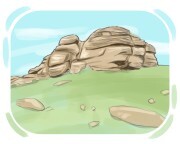
a visible exposure of rock or geological strata at the Earth's surface, often occurring on hillsides, cliffs, or other elevated areas, providing insight into the underlying geological structure

Ex: Fossils embedded in the outcrop offered a glimpse into the prehistoric life that once inhabited the region .
Close
Sign in
bedrock
bedrock
[noun]

solid rock beneath surface materials, forming the Earth's crust foundation

Ex: Fossils embedded in the bedrock provided valuable information about ancient ecosystems and environmental conditions .
Close
Sign in
mantle
mantle
[noun]

the region of the Earth's interior, lying beneath the crust and extending to the outer core, composed of solid rock that can deform and flow over geological time scales

Ex: Rocks in the upper mantle exhibit properties that allow them to undergo plastic deformation over long periods.
Close
Sign in
LanGeek
Download LanGeek app