Vocabulary for IELTS Academic (Band 6-7) - Geometry

Here, you will learn some English words related to Geometry that are necessary for the Academic IELTS exam.

review-disable

review

flashcard-disable

flashcard

spelling-disable

spelling

quiz-disable

quiz

start-learning
Vocabulary for IELTS Academic (Band 6-7)
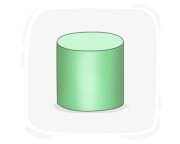
cylinder [noun]

(geometry) a solid or hollow shape with two circular bases at each end and straight parallel sides

Ex: The artist sculpted a beautiful marble cylinder as part of a modern art installation .
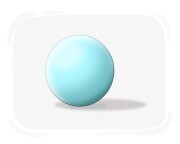
sphere [noun]

(in geometry) a three-dimensional surface where all points are equidistant from a center

Ex: Spheres are often used in design for their smooth and harmonious appearance .
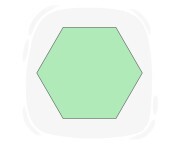
hexagon [noun]

(geometry) a closed shape with six straight sides and six angles
Ex: She decided to tile her bathroom floor with hexagon-shaped tiles.
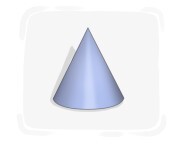
cone [noun]

(geometry) a three dimensional shape with a circular base that rises to a single point

Ex:
tangent [noun]

(mathematics) the ratio of the opposite to the adjacent side of a triangle that has one angle of 90°
Ex: If the tangent of an angle is 1 , it means the height and base of our triangle are the same .
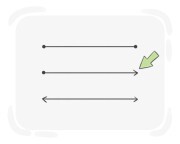
ray [noun]

a straight line that starts at a point and extends infinitely in one direction
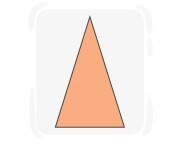
Ex: A ray has a definite starting point but no end .

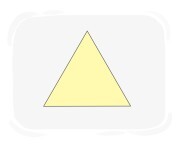
a type of triangle that has two sides of equal length and two angles of equal measure
Ex: The altitude drawn from the vertex angle of an isosceles triangle bisects the base into two equal segments .
octagon [noun]

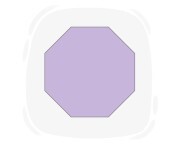
(geometry) a polygon consisting of eight straight sides and eight angles

Ex: Each of the eight sides of the octagon was painted a different color .
swirl [noun]

in geometry, a pattern or shape that exhibits a twisting or spiraling motion, often characterized by continuous, curved lines forming a rotational or helical design

Ex: An artistic representation of wind currents might include swirls to convey the fluid dynamics .
vertex [noun]

a point where two or more lines, edges, or rays meet to form an angle, or the point at which the sides of a polygon intersect
Ex: The meeting point of the two arms of an angle is referred to as the vertex of the angle .
ellipse [noun]

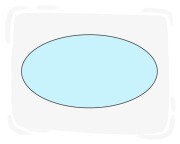
(geometry) a closed plane curve that has two focal points

polygon [noun]

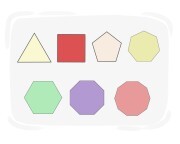
(geometry) a flat shape consisting of three or more straight sides
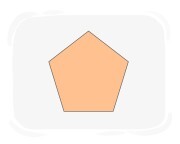
Ex: The stop sign is an example of an octagonal polygon .
pentagon [noun]

a geometric shape with five angles and five straight sides

Ex: The stop sign is shaped like a red pentagon to alert drivers to halt .
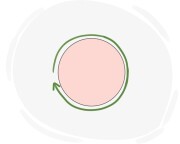
helix [noun]

(geometry) a line curved on a conical or cylindrical surface, like a spiral staircase in shape
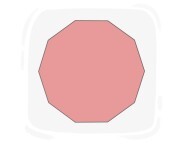
decagon [noun]

(geometry) a flat polygon with ten straight sides and ten angles
Ex: Architects sometimes incorporate shapes like the decagon into their designs for a unique appearance .
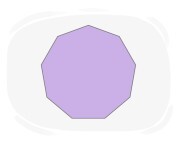
nonagon [noun]

(geometry) a flat shape consisting of nine straight sides and nine angles

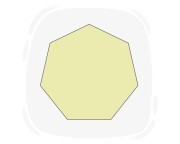
heptagon [noun]

a seven-sided plane shape consisting of seven line segments or edges that meet at seven interior angles

Ex: One version of the game featured a board laid out in a grid of non-uniform heptagons instead of the usual squares .

a three-dimensional shape similar to a stretched or compressed sphere
Ex: In geodesy , the reference ellipsoid is used as a mathematical model to represent the Earth 's shape .
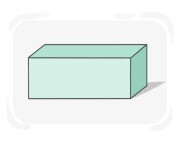
cuboid [noun]

a three-dimensional geometric shape with six rectangular faces, resembling a box or a rectangular prism
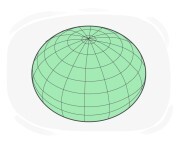
spheroid [noun]

(geometry) a round 3D shape like a ball that is slightly flattened at the top and bottom points
Ex: The Earth is not quite a sphere but is better described as an oblate spheroid flattened at the poles .
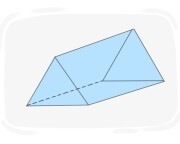
prism [noun]

(geometry) a solid figure with flat sides and two parallel ends of the same size and shape
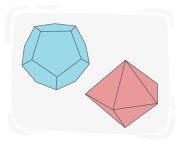
a solid shape made of flat sides that fit together along their edges
Ex: The polyhedron 's vertices are the points where its edges meet .
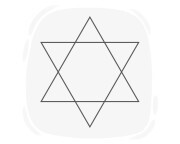
hexagram [noun]

(geometry) a flat star-shaped figure with six points that can be formed by making equilateral triangles on each side of a regular hexagon

an angle that measures either less or more that 90 degrees
Ex: A 45-degree angle is considered an oblique angle , falling between 0 and 90 degrees .

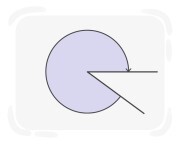
an angle that measures greater than 180 degrees but less than 360 degrees
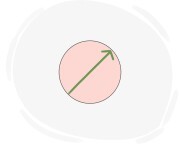
diameter [noun]

a straight line from one side of a round object, particularly a circle, passing through the center and joining the other side

Ex: The engineer measured the diameter of the pipe to ensure it would fit snugly within the existing framework .

(geometry) the length of the external boundary of a curved shape, especially a circle
Ex: To find the circumference of a wheel , you need to know its radius or diameter .
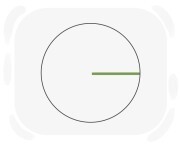
radius [noun]

the length of a straight line drawn from the center of a circle to any point on its outer boundary

Ex: The architect calculated the radius of the dome to ensure its proportions were aesthetically pleasing .
Vocabulary for IELTS Academic (Band 6-7)
Size and Scale Dimensions Weight and Steadiness Increase in Amount
Decrease in Amount Intensity Time and Duration Space and Area
Shapes Speed Significance Insignificance
Strength and Influence Uniqueness Commonness Complexity
High Quality Low Quality Value Challenges
Wealth and Success Poverty and Failure Age and Appearance Body Shape
Wellness Intellectual Capability Intellectual Incapabilities Positive Human Traits
Negative Human Traits Moral Traits Financial Behaviours Social Behaviours
Short-tempered Traits Positive Emotional Responses Negative Emotional Responses Positive Emotional States
Negative Emotional States Tastes and Smells Sounds Textures
Temperature Probability Attempt and Prevention Opinions
Thoughts and Decisions Encouragement and Discouragement Knowledge and Information Request and Suggestion
Respect and Approval Regret and Sadness Relational Actions Physical Actions and Reactions
Body Language and Gestures Postures and Positions Movements Engaging in Verbal Communication
Understanding and Learning Perceiving The Senses Commanding and Giving Permissions Predicting
Touching and Holding Changing and Forming Creating and Producing Organising and Collecting
Preparing Food Eating and Drinking Science Education
Research Astronomy Physics Biology
Chemistry Geology Philosophy Psychology
Maths and Graphs Geometry Environment Landscape and Geography
Engineering Technology Internet and Computer Manufacture and Industry
History Religion Culture and Custom Language and Grammar
Arts Music Film and Theatre Literature
Architecture Marketing Finance Management
Medicine Sickness and Symptoms Law Energy and Power
Crime Punishment Government Politics
Measurement War Positive Emotions Negative Emotions
Travel and Tourism Migration Food and Drinks Materials
Pollution Disasters Weather Animals
Adverbs of Manner Adverbs of Degree Adverbs of Comment and Certainty Adverbs of Time and Frequency
Adverbs of Purpose and Emphasis Conjunctive Adverbs