Vocabulary for IELTS Academic (Band 6-7) - Physics

Here, you will learn some English words related to Physics that are necessary for the Academic IELTS exam.

review-disable

review

flashcard-disable

flashcard

spelling-disable

spelling

quiz-disable

quiz

start-learning
Vocabulary for IELTS Academic (Band 6-7)
resistor [noun]

an electrical component designed to limit or control the flow of electric current in a circuit, typically by providing resistance
Ex: The color-coded bands on resistors indicate their resistance value , tolerance , and sometimes temperature coefficient .

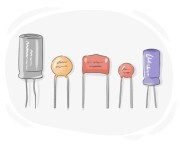
an electric device that is used to accumulate electric charge

the branch of physical science that deals with the relationships between heat, work, and energy, particularly the principles governing the conversion of various forms of energy

Ex: The second law of thermodynamics introduces the concept of entropy , indicating that natural processes tend to increase disorder in a closed system .

(physics) an invisible substance that makes up most of the universe's mass, detectable only through its gravitational effects

Ex: Despite extensive research efforts , the true nature of dark matter remains one of the biggest mysteries in astrophysics .
photon [noun]

a fundamental particle of light that carries electromagnetic energy and exhibits both particle-like and wave-like properties
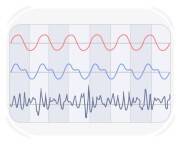
Ex: The dual nature of photons is described by wave-particle duality , a fundamental concept in quantum mechanics .

the specific number of waves that pass a point every second

Ex: The radio station broadcasts at a frequency of 101.5 megahertz .

the distance between a point on a wave of energy and a similar point on the next wave

Ex: The wavelength of a radio wave determines its frequency and how it interacts with antennas .

the action or process where a wave, such as light or sound, bounces back from a surface instead of passing through

Ex: The calm lake 's surface served as a perfect mirror , providing a clear reflection of the surrounding mountains .
momentum [noun]

the strength of a moving object determined by multiplying how heavy it is by how fast it is going

Ex: The cyclist 's momentum helped him climb the steep hill .
inertia [noun]

the tendency of an object to resist changes in its state of motion, whether at rest or in uniform motion, and to remain in its current state unless acted upon by an external force

Ex: In space , where there is no air resistance , an object set in motion will continue moving indefinitely due to its inertia .

(physics) the back-and-forth motion of an object between two end points
Ex: Gravitationally bound binary star systems undergo regular orbital oscillations as the pair revolve around their mutual center of mass .

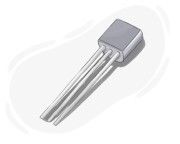
a small semiconductor device, used in television and radio sets, able to amplify or rectify an electric current

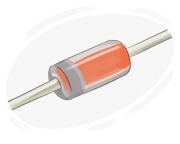
diode [noun]

an electronic device with two terminals, typically allowing the flow of current in one direction only

inductor [noun]

an electronic component that stores energy in a magnetic field when an electric current flows through it; typically consists of a coil of wire

Ex: Transformers utilize inductors to transfer electrical energy between different circuits by inducing a changing magnetic field in a nearby coil .

the study of the behavior of air as it interacts with solid objects, particularly the flow of air around and through objects, and the effects of this interaction on the objects

Ex: Car manufacturers use aerodynamics to design vehicles that have improved fuel efficiency by minimizing drag and maximizing stability .
Vocabulary for IELTS Academic (Band 6-7)
Size and Scale Dimensions Weight and Steadiness Increase in Amount
Decrease in Amount Intensity Time and Duration Space and Area
Shapes Speed Significance Insignificance
Strength and Influence Uniqueness Commonness Complexity
High Quality Low Quality Value Challenges
Wealth and Success Poverty and Failure Age and Appearance Body Shape
Wellness Intellectual Capability Intellectual Incapabilities Positive Human Traits
Negative Human Traits Moral Traits Financial Behaviours Social Behaviours
Short-tempered Traits Positive Emotional Responses Negative Emotional Responses Positive Emotional States
Negative Emotional States Tastes and Smells Sounds Textures
Temperature Probability Attempt and Prevention Opinions
Thoughts and Decisions Encouragement and Discouragement Knowledge and Information Request and Suggestion
Respect and Approval Regret and Sadness Relational Actions Physical Actions and Reactions
Body Language and Gestures Postures and Positions Movements Engaging in Verbal Communication
Understanding and Learning Perceiving The Senses Commanding and Giving Permissions Predicting
Touching and Holding Changing and Forming Creating and Producing Organising and Collecting
Preparing Food Eating and Drinking Science Education
Research Astronomy Physics Biology
Chemistry Geology Philosophy Psychology
Maths and Graphs Geometry Environment Landscape and Geography
Engineering Technology Internet and Computer Manufacture and Industry
History Religion Culture and Custom Language and Grammar
Arts Music Film and Theatre Literature
Architecture Marketing Finance Management
Medicine Sickness and Symptoms Law Energy and Power
Crime Punishment Government Politics
Measurement War Positive Emotions Negative Emotions
Travel and Tourism Migration Food and Drinks Materials
Pollution Disasters Weather Animals
Adverbs of Manner Adverbs of Degree Adverbs of Comment and Certainty Adverbs of Time and Frequency
Adverbs of Purpose and Emphasis Conjunctive Adverbs