Cambridge IELTS 18 - Academic - Test 2 - Reading - Passage 1 (3)

Here you can find the vocabulary from Test 2 - Reading - Passage 1 (3) in the Cambridge IELTS 18 - Academic coursebook, to help you prepare for your IELTS exam.

review-disable

review

flashcard-disable

flashcard

spelling-disable

spelling

quiz-disable

quiz

start-learning
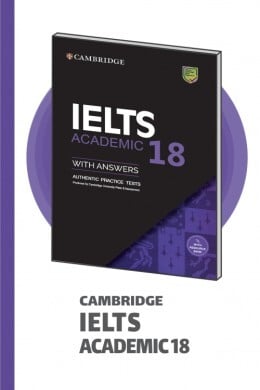
Cambridge IELTS 18 - Academic
distinct [adjective]

separate and different in a way that is easily recognized

Ex: Each flavor of ice cream has a distinct taste , making it easy to identify even when blindfolded .
tribe [noun]

a social group united by shared ancestry, culture, or customs

to be one of the causes or reasons that helps something happen

Ex: Volunteer efforts significantly contribute to the charity 's growth .

to take responsibility for something and start to do it

Ex: Entrepreneurs often undertake the challenge of launching and managing their own businesses .
artifact [noun]

a man-made object, tool, weapon, etc. that was created in the past and holds historical or cultural significance

Ex: Each artifact in the exhibit told a story about the civilization that created it .
agrarian [adjective]

related to agriculture, farmers, or rural life

Ex: The government implemented agrarian policies to support and develop the agricultural sector .
indigenous [adjective]

relating to the original inhabitants of a particular region or country, who have distinct cultural, social, and historical ties to that land

Ex: The festival celebrated the rich cultural heritage of the indigenous people , featuring traditional music , dance , and crafts .
communal [adjective]

belonging to or shared by a group of people and not only individuals

Ex: The communal bathroom was cleaned daily .

someone who comes to live in a foreign country

Ex: The city 's diverse population includes many immigrants from various parts of the world .

to firmly and persistently express an opinion, belief, or statement as true and valid
Ex: The scientist maintains that climate change is a significant threat that needs immediate attention .
native [adjective]

describing the people who have lived in an area for a very long time

Ex:

to be related by blood, typically referring to the lineage or family connection

Ex: The royal family can trace its lineage and claim to descend from kings and queens of old .
surround [noun]

the area or conditions immediately around something or someone where it exists or operates
Ex: The cozy surround of the cabin provided a peaceful retreat .

a person whose job is designing buildings and typically supervising their construction

Ex: The architect presented the blueprints for the new community center to the city council for approval .
shadowy [adjective]

faint or unclear, often making it hard to see or understand fully

Ex: The shadowy outline of the mountains was barely visible through the mist .
at best [phrase]

‌used when you take the most optimistic view, especially in a bad situation

purpose [noun]

the reason or intention for which something is made, done, or used

Ex: She explained the purpose of the experiment to her science class .
striking [adjective]

exceptionally eye-catching or beautiful

Ex: His striking blue hair and elaborate tattoos made him a memorable figure in the local art scene .

an agreement reached by all members of a group

Ex: The political parties struggled to find consensus on the controversial immigration policy .
majority [noun]

the larger part or number of a given set or group

Ex: The majority of the class agreed on extending the deadline for the assignment .
to serve [verb]

to be suitable, advantageous, or occur at a convenient or favorable time

Ex: The conditions served in their favor during the competition .
function [noun]

the purpose or intended use of something

Ex: The function of the key is to unlock the door .

to learn of and confirm the facts about something through calculation or research

Ex: Last month , the investigators determined the cause of the fire in the building .

a scientist who studies or observes planets, stars, and other happenings in the universe

Ex: She became an astronomer because of her fascination with the mysteries of the cosmos .
cluster [noun]

a grouping or concentration of data points in a specific region, often used in statistics and data analysis to describe a set of values that are close to each other

Ex: When examining the distribution of test scores , a cluster of high scores may suggest a group of high-achieving students .
megalithic [adjective]

of or relating to megaliths or the people who erected megaliths

to match or be similar to something else

Ex: Her actions are corresponding with her words , indicating sincerity .

an observable fact, event, or situation, often unusual or not yet fully explained

Ex: Scientists study each phenomenon carefully .
eclipse [noun]

a period during which the sun or moon is temporarily obscured by the shadow of another celestial body

Ex: An eclipse occurs when the Earth , moon , and sun align perfectly .

to be subjected to or experience a particular reaction or feedback from others

Ex: His proposal to revamp the company 's marketing strategy received cautious optimism from the board of directors .
considerable [adjective]

large in quantity, extent, or degree

Ex: The storm left a considerable amount of debris scattered across the neighborhood .

a general interest that leads people to want to know more
critic [noun]

someone who evaluates and provides opinions or judgments about various forms of art, literature, performances, or other creative works
Ex:
to lack [verb]

to be without or to not have enough of something that is needed or desirable

Ex: The garden lacked proper sunlight , hindering the growth of certain plants .
cover [noun]

the act of hiding something from sight by blocking the view
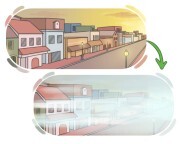
Ex:

to conceal or hide something

Ex: The overgrown trees obscured the entrance to the trail .

to find out about something, particularly by doing research
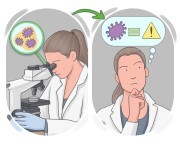
Ex: Genealogists unearthed old records and documents to trace the family 's ancestry back several generations .

to form a theory or opinion about a subject without knowing all the facts

Ex: When the stock prices suddenly dropped , investors started to speculate on the reasons for the market downturn .
healing [noun]

the process of becoming healthy again after an injury or illness

Ex: The doctor was impressed by the rapid healing of the surgical wound .
curative [adjective]

able to heal or relieve a medical condition

Ex: The ointment proved curative for the skin infection .
Iron Age [noun]

the period that began about 1100 BC when people used iron tools for the first time

Ex: The discovery of iron-smelting techniques allowed Iron Age cultures to produce stronger and more efficient tools .
Common Era [adverb]

used with a date to refer to things happened or existed after the birth of Christ

Ex:
pit [noun]

a large hole in the ground where stones, minerals, or other materials are removed

Ex: They discovered an old pit filled with water after heavy rain .
to arise [verb]

to begin to exist or become noticeable

Ex: Tensions began to arise among team members due to differing opinions on the project 's direction .

a sedimentary rock composed of sand-sized grains, commonly used in construction for its durability and natural beauty

spot [noun]

a specific point or location identified relative to surrounding features in an area or region
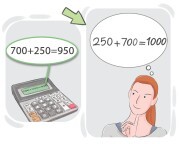
Ex: We picked a spot under the tree for our picnic .

used to say that something such as a number or amount is not exact

Ex: The meeting is scheduled to start at 3 PM , give or take approximately 15 minutes .
finding [noun]

a piece of information discovered as a result of a research

Ex: His finding on the chemical reaction led to a breakthrough in the experiment .
equinox [noun]

either of the two moments in a year when the Sun, in its apparent motion along the ecliptic, crosses the celestial equator, resulting in approximately equal periods of daylight and darkness worldwide

Ex: The equinox occurs twice a year , once in March and once in September .
Cambridge IELTS 18 - Academic
Test 1 - Listening - Part 1 Test 1 - Listening - Part 2 (1) Test 1 - Listening - Part 2 (2) Test 1 - Listening - Part 3 (1)
Test 1 - Listening - Part 3 (2) Test 1 - Listening - Part 4 (1) Test 1 - Listening - Part 4 (2) Test 1 - Reading - Passage 1 (1)
Test 1 - Reading - Passage 1 (2) Test 1 - Reading - Passage 2 (1) Test 1 - Reading - Passage 2 (2) Test 1 - Reading - Passage 3 (1)
Test 1 - Reading - Passage 3 (2) Test 2 - Listening - Part 1 Test 2 - Listening - Part 2 (1) Test 2 - Listening - Part 2 (2)
Test 2 - Listening - Part 3 (1) Test 2 - Listening - Part 3 (2) Test 2 - Listening - Part 4 Test 2 - Reading - Passage 1 (1)
Test 2 - Reading - Passage 1 (2) Test 2 - Reading - Passage 1 (3) Test 2 - Reading - Passage 2 (1) Test 2 - Reading - Passage 2 (2)
Test 2 - Reading - Passage 2 (3) Test 2 - Reading - Passage 3 (1) Test 2 - Reading - Passage 3 (2) Test 2 - Reading - Passage 3 (3)
Test 3 - Listening - Part 1 Test 3 - Listening - Part 2 Test 3 - Listening - Part 3 Test 3 - Listening - Part 4
Test 3 - Reading - Passage 1 (1) Test 3 - Reading - Passage 1 (2) Test 3 - Reading - Passage 2 (1) Test 3 - Reading - Passage 2 (2)
Test 3 - Reading - Passage 3 (1) Test 3 - Reading - Passage 3 (2) Test 4 - Listening - Part 1 Test 4 - Listening - Part 2
Test 4 - Listening - Part 3 Test 4 - Listening - Part 4 Test 4 - Reading - Passage 1 (1) Test 4 - Reading - Passage 1 (2)
Test 4 - Reading - Passage 2 (1) Test 4 - Reading - Passage 2 (2) Test 4 - Reading - Passage 3 (1) Test 4 - Reading - Passage 3 (2)