Essential Vocabulary for TOEFL - Time and History

Here you will learn some English words about time and history, such as "century", "decade", "eternity", etc. that are needed for the TOEFL exam.

review-disable

review

flashcard-disable

flashcard

spelling-disable

spelling

quiz-disable

quiz

start-learning
Essential Vocabulary for TOEFL
era [noun]

a period of history marked by particular features or events

Ex: The Industrial Revolution ushered in an era of rapid technological and economic change .

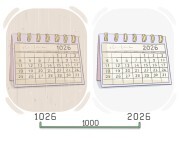
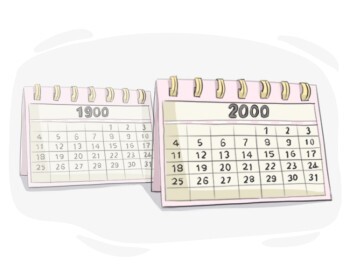
a period of one thousand years, usually calculated from the year of the birth of Jesus Christ

Ex: The medieval cathedral took nearly a millennium to complete , showcasing exquisite craftsmanship .
millennial [adjective]

relating to a time span of a thousand years
Ex: The historian studied millennial trends in climate change over the past thousand years .
century [noun]

a period of one hundred years

Ex: The city celebrated its third century of existence last year .
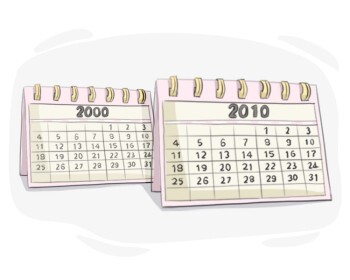
decade [noun]

ten years of time

Ex: Over the past decade , the city 's population has doubled .
age [noun]

a period of history identified with a particular event
Ex: An age of economic prosperity followed the industrial revolution , leading to increased wealth and development .
chronological [adjective]

organized according to the order that the events occurred in

Ex:
eternity [noun]

time that is endless

Ex: Love , they say , lasts for an eternity , transcending the boundaries of time and space .
eventual [adjective]

happening at the end of a process or a particular period of time

Ex: The eventual outcome of the negotiations was a mutually beneficial agreement for all parties involved .
annually [adverb]

in a way that happens once every year

Ex: The company hosts a charity event annually .
biannual [adjective]

taking place twice a year

Ex: The biannual sale at the department store attracts shoppers from all over the city .

for an unspecified period of time

Ex: The construction project is on hold indefinitely until funding is secured .

after a particular event or time

Ex: She gave a brief introduction and subsequently opened the floor to questions .

at exactly the same time

Ex: The conference was broadcast simultaneously to a global audience .
beforehand [adverb]

at an earlier time

Ex: Parking permits expire at noon ; renew them beforehand .
frequently [adverb]

regularly and with short time in between
Ex: The manager frequently communicates updates to the team .
instantly [adverb]

with no delay and at once

Ex: Upon hearing the news , she reacted instantly .
former [adjective]

referring to the first of two things mentioned

Ex:
latter [adjective]

referring to the second of two things mentioned

Ex:

a year in every four years that has 366 days instead of 365
Ex: The next leap year will be in 2024 .
seasonal [adjective]

typical or customary for a specific time of year

Ex: She decorated her home with seasonal decorations for Halloween .
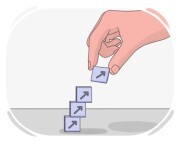
solstice [noun]

either of the two times of the year when the sun reaches its farthest or closest distance from the equator
Ex:
continual [adjective]

happening repeatedly or continuously in an annoying or problematic way
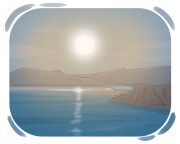
Ex: The continual rain caused flooding in low-lying areas .
daybreak [noun]

the time in the very early morning when the first sunlight appears

dusk [noun]

the time after sun sets that is not yet completely dark

Ex: The garden took on a magical aura at dusk , with fireflies dancing among the flowers and the scent of jasmine lingering in the air .

a period of 12 lunar months (the time span between two new moons), which is around 354 days

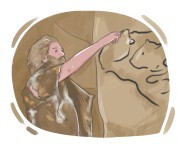
later on [adverb]

after the time mentioned or in the future
Ex:
prehistoric [adjective]

relating or belonging to the time before history was recorded
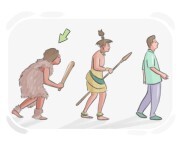
Ex: The museum exhibit showcased prehistoric fossils of dinosaurs and other ancient creatures .
primitive [adjective]

characteristic of an early stage of human or animal evolution

Ex: The discovery of primitive plants helped scientists understand ancient ecosystems .

a society that has developed its own culture and institutions in a particular period of time or place

Ex: Many aspects of Greek civilization influence contemporary philosophy and art .

someone who studies or records historical events

Ex: The museum consulted a historian to verify the artifact 's origin .
medieval [adjective]

belonging or related to the Middle Ages, the period in European history from roughly the 5th to the 15th century

Ex: Historians often refer to the time between the fall of the Roman Empire and the Renaissance as the medieval period .

an idealized or imagined period of peace, prosperity, and happiness

Ex: People often look back nostalgically on the golden age of childhood .
archive [noun]

a place or a collection of records or documents of historical importance

Ex: The museum curator carefully preserved the old photographs in the museum 's archive .
origin [noun]

the point or place where something has its foundation or beginning

Ex: The origin of the word can be found in Latin .
anno Domini [adverb]

used to refer to a date that is after the birth of Jesus Christ

Ex:
monument [noun]

a place or building that is historically important

Ex: The Lincoln Memorial in Washington , D.C. , is a monument dedicated to the 16th President of the United States .
Common Era [adverb]

used with a date to refer to things happened or existed after the birth of Christ

Ex: