C1 Level Wordlist - Politics

Here you will learn some English words about politics, such as "radical", "dictator", "activism", etc. prepared for C1 learners.

review-disable

review

flashcard-disable

flashcard

spelling-disable

spelling

quiz-disable

quiz

start-learning
C1 Level Wordlist
to lobby [verb]

to make an attempt to persuade politicians to agree or disagree with a law being made or changed

Ex: Advocacy groups regularly lobby for changes in healthcare legislation to better serve the public .

to make a society, law, system, or organization better or more effective by making many changes to it

Ex: The organization plans to reform its fundraising strategies to increase revenue and support its mission .
diplomatic [adjective]

related to the work of keeping or creating friendly relationships between countries

Ex: The president 's diplomatic visit to the foreign country strengthened bilateral ties .
sovereign [adjective]

(of a country or state) self-governed and free from external control
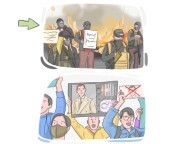
Ex: The island nation fought long and hard to become sovereign , achieving independence from its colonizers .
radical [adjective]

supporting total and extreme social or political changes

Ex: The party 's radical proposal for healthcare reform divided public opinion .
activism [noun]

the action of striving to bring about social or political reform, especially as a member of an organization with specific objectives

Ex: Social media has become a powerful tool for activism , allowing campaigns to reach a global audience .
activist [noun]

a person who tries to bring about political or social change, especially someone who supports strong actions such as protests, etc.

Ex: The human rights activist spoke passionately about the need for justice and equality during the rally .

a senior official whose job is living in a foreign country and representing their own country

Ex: The ambassador met with the foreign minister to discuss trade agreements and international cooperation .
dictator [noun]

a ruler that has total power over a state, particularly a ruler who gained power through force

Ex: Many people fled the country to escape the oppressive rule of the dictator .

someone who makes decisions about the policies that a government or organization follows

Ex: During the conference , policy makers from around the world discussed strategies to combat climate change .

information and statements that are mostly biased and false and are used to promote a political cause or leader

Ex: The documentary exposed how propaganda was used to manipulate public opinion .
autonomy [noun]

(of a country, region, etc.) the state of being independent and free from external control

Ex: Many people believe that granting autonomy to the province would lead to greater stability .

the official laws and principles by which a country or state is governed

Ex: The Indian constitution is one of the longest and most detailed in the world , outlining the structure of government and the rights of its people .

the act or process of making laws or passing a statute

Ex: The Supreme Court ruled that the recent legislation restricting voting rights was unconstitutional .
mandate [noun]

the legality and power given to a government or other organization after winning an election

Ex: The referendum resulted in a clear mandate for independence , prompting negotiations with the central government .

a system of government that is controlled by officials who are not elected rather employed

Ex:
cabinet [noun]

senior members of a government who make decisions and control the policy of the government

Ex: The cabinet members deliberated for hours before reaching a consensus on the proposed healthcare reforms .
commerce [noun]

the act of buying and selling goods and services, particularly between countries

Ex:

a system of international trading in which there are no restrictions or taxes on goods bought or sold

Ex: Critics of free trade worry that it could lead to job losses in certain industries that struggle to compete with cheaper imports .
poll [noun]

a process in which random people are asked the same questions to find out what the general public thinks about a given subject

Ex: A nationwide poll conducted last month showed overwhelming support for stricter gun control laws .
alliance [noun]

a formal agreement or treaty establishing cooperation between nations or groups for shared objectives

Ex: The business alliance between the two tech giants led to the development of innovative new products .
ally [noun]

a country that aids another country, particularly if a war breaks out

Ex: As an ally , they agreed to assist in military operations and share intelligence .

an alliance between two or more countries or between political parties when forming a government or during elections

Ex: The opposition parties formed a coalition to challenge the ruling party in the upcoming elections .
coup [noun]

an unexpected, illegal, and often violent attempt to change a government

Ex: International condemnation followed the military 's coup d'état , urging a return to democratic governance .
exile [noun]

the situation of someone who is sent to live in another country or city by force, particularly as a penalty or for political reasons

Ex: Many intellectuals and activists fled into exile to escape persecution and censorship .
wing [noun]

members of a political party or other organization who have a certain function or share certain views

Ex: The moderate wing of the coalition sought bipartisan solutions to healthcare reform .
treaty [noun]

an official agreement between two or more governments or states

Ex: The environmental treaty aimed to reduce greenhouse gas emissions and protect biodiversity .

an economic and political system in which industry, businesses, and properties belong to the private sector rather than the government

Ex: Critics of capitalism argue that it leads to income inequality and exploitation of labor .

a political system in which the government controls all industry, every citizen is equally treated, and private ownership does not exist

Ex:

religious or political actions, beliefs, or ideas that most people find them extreme, unreasonable, and abnormal

Ex: Extremism often feeds on economic instability and social discontent , making it a complex issue to address .
fascism [noun]

an extreme right-wing political attitude or system characterized by a strong central government, aggressively promoting one's country or race above others, as well as prohibiting any opposition

Ex: Many historians study the factors that contributed to the spread of fascism in Italy and Germany .

a political system in which a central government controls the affairs of each self-governed state

Ex: Debates over federalism often center on the appropriate level of state versus federal control in various policy areas .

a belief in which the actions of one country affect all other countries in the world and that economic policy is built on benefiting the whole world not an individual country

Ex: Proponents of globalism believe that it promotes peace and understanding by encouraging cooperation and exchange between countries .

the political belief that promotes personal freedom, democracy, gradual changes in society, and free trade

Ex: Advocates of liberalism often push for gradual social reforms to address inequalities and enhance the welfare of all citizens .

an economic system in which the state owns and manages major resources, industries, or capital

Ex: Economists analyzed the advantages and disadvantages of socialism .
administrative [adjective]

related to the management and organization of tasks, processes, or resources within an organization or system

Ex: Administrative tasks such as payroll processing and budget management are essential for business operations .
congressional [adjective]

relating to the United States Congress, which makes laws and oversees the government

Ex: Congressional representatives are elected to serve in the House of Representatives and the Senate .
constitutional [adjective]

relating to or in accordance with the rules laid out in a constitution, which is a set of fundamental laws for a country or organization

Ex: Constitutional rights protect citizens ' freedoms and limit government power .
electoral [adjective]

related to voting, elections, or the process of choosing representatives through voting mechanisms

Ex: Electoral reforms aim to improve the fairness and transparency of the voting process .
interim [adjective]

intended to last only until something permanent is presented

Ex: She served as interim director for six months after the previous one resigned unexpectedly .
protocol [noun]

a set of rules and appropriate behavior that officials use on formal occasions

Ex: During royal ceremonies , there are protocols for how members of the royal family should enter and exit the room .
to table [verb]

to formally bring up a proposal, discussion, etc. at a meeting for consideration

Ex: The committee will table the report on environmental sustainability at the next session .

a group of people who work for and accompany a person of power or fame

Ex: The royal family 's entourage included diplomats , courtiers , and personal aides , all impeccably dressed for the occasion .

a policy of giving in to the demands of others in order to maintain peace, often at the cost of one's own principles or values

Ex: His constant appeasement of his demanding boss eventually led to a promotion , as he was seen as a team player .